Showing posts with label Brands. Show all posts

Tuesday, March 13, 2012

The Fate of the Banana and its Probable Extinction

I just finished reading Dan Keoppel's book, "Banana:  The Fate of the Fruit That Changed the World".

Published in 2008, it's a fascinating journey through the history of the banana and how civilizations, government rulers, wars and mega-companies have evolved from this relatively inexpensive and humble fruit that outsells apples and oranges combined.

Dan briefly glimpses at the strong chemicals (the banana requires more pesticide than any other fruit) used in the growing of bananas and the significant physical harm it causes to the workers bodies (the movie trailer below shows the physical harm caused by Dole spraying chemicals on their farms) and the surrounding landscape, but the bulk of the book is focused on the bananas remarkable global growth (especially since the male portion of the banana tree is sterile) and the Panama Disease that threatens its very existence.

The most fascinating elements of the book to me were:

  • learning that the banana tree (it's really classified as an herb) reproduces through a Mother/Daughter relationship offering new shoots from the original tree that can be transplanted since the male portion is sterile.
  • learning that the banana our grandparents and parents grew up eating, the Gros Michel, is virtually eliminated from existence due to the onslaught of Panama Disease -- of which there is no cure.  The Gros Michel (or Big Mike) was bigger, hardier fruit that had a better taste and texture.
  • learning that the new banana plant, the Cavendish (originally considered rubbish by Chiquita when the Gros Michel was still around), is under the first rounds of attack from Panama Disease and may sadly only be viable as a commercial fruit for 10-30 more years.
  • learning that Chiquita and Dole are feverishly working to create the next banana that will withstand the attack of Panama Disease and that hopefully they can pull it off through cross-breeding and not genetic manipulation -- though both methods have proven unsuccessful for more than a decade.
  • learning that the forbidden fruit in the story of Genesis may have been the banana with a strong case for that being the case.
  • learning about the politics and mergers that created Chiquita and Dole.

If you're a foodie, you will appreciate this book and will appreciate even more your next banana.  People 30 years from now may not have the same opportunity.

Monday, February 20, 2012

Marshmallow and Fluff

We had some great family time today that included building a fire in the fireplace.  After dinner we decided to make even more use of the open flames and got some marshmallows and chocolate and our graham crackers for some old-fashioned smores.

Standing in the grocery store, I was torn.  I stood reading the labels of the only two options for large marshamllows -- the store brand and Kraft.  The ingredients were in slightly different order, but otherwise exactly the same.  And I wasn't happy with either.  Now, I know that a marshmallow would never be considered a health food, but what was blue #1 dye doing in a white marshmallow?

I knew I should just pass, but I also had the weight of kids waiting for a smore back home.  Our son, with food allergies to the junk in processed foods, had never had a marshmallow before.

Ingredients being the same, I chose the cheaper store brand and headed for home to much fanfare when I opened the door.  They were ready for roasting marshmallows!

Our son was nearing the completion of his smore when he bolted as fast as he could to the kitchen sink just in time to vomit up his smore and dinner.  My better judgement told me I shouldn't have given him the marshmallow.  Mistakes happen.  The bag of marshmallows now sits in our trash.

We talked about options for future smores and decided to stick with Fluff.  If you aren't familiar with Fluff, it is a small Massachusetts company that was the original producer of marshmallow cream.  But the better news is that they have stuck to the original recipe which only includes three ingredients:  corn syrup, sugar and vanilla.  Next time, we will swipe a bit of Fluff across the graham cracker to make our smores -- and just skip the roasting part.

There may be some organic options at the health foods store.  Organic marshmallows, if there is such a thing, would at least have limited (necessary) ingredients and almost assuredly no artificial colors.

Can anybody recommend a better marshmallow option?

Tuesday, February 14, 2012

Instant vs. Dry Active Yeast

When I started making bread for our family on a regular basis, I came across bread recipes that called for "instant yeast".  I had only used active dry yeast -- of which Red Star and Fleischmann's are the most common brands.  Was it the same thing I wondered?  I made a return trip to our grocery store and couldn't find "instant yeast" anywhere.

Some time went by and I saw it again.  This time I did some research and discovered that instant yeast is available at King Arthur Flour, health stores and some grocery stores and is generally sold under the SAF brand name -- an affiliate of Red Star brand.

So what's the difference?  It's in the processing.

Active dry yeast is less active from the start, though it doesn't require proofing as it did in the past.  Instant yeast is, well, instant.  And it can be used straight from the freezer where it should be stored once opened.

The difference between the two is most noticed in the opening rise time where one can visibly see the instant yeast performing quicker from the start with a rapid dough rise.  However, the active dry yeast eventually catches up over an extended period of rise time.

Yeast makes some nervous.  It shouldn't.  A tremendous resource to learn more about everything yeast (and the instant vs. active dried) can be found at King Arthur's web site.

We personally prefer (as do most professional chefs and King Arthur bakers) the SAF instant yeast and have always achieved good results with it.

What do you use and why?  What is your yeast experience in bread baking?

Sunday, February 12, 2012

Spindrift Soda Update

Box of Sprindrift Soda
After my first post on Spindrift, I wrote owner Bill Creelman to inform him of my blog and wish him the best in his soda business.

Because Spindrift isn't available in West Michigan, I wasn't able to comment directly on the taste -- only the concept, values and mission of the company.

All six colorful Spindrift flavors
To my pleasant surprise, Bill wrote back, said he liked the blog and offered to send me some samples.  I was delighted a week later to receive my package of bottles.  In exchange for the favor, I hosted a tasting party with friends and family to get their opinions and brought samples to a local restaurant, Marie Catrib's, and a local health food grocery store chain, Harvest Health Foods, to get their feedback.

In a nutshell, all of the tasters were completely delighted with the taste and appreciated the values of the company.  More on this in a moment.

Pulp in Spindrift Soda
The sodas arrived in a carefully packaged box from Famous Foods.  I pulled each bottle out and first noticed the bright colors and pulp in each bottle.  It is the pulp that carried a lot of visual appeal to those looking for natural unadulterated foods.

The sodas have about 70 calories -- much less than a regular soda.The bottle label indicates the amount of real fruit is in each bottle such as "made with 16 raspberries, 9 cranberries and fresh squeezed lemon juice" or "made with 1/4 of a fresh squeezed grapefruit and fresh squeezed lemon juice".

The soda introduces itself with a playful sentence on the side of the label that says, "Sodas.  A Reintroduction. -- I'm sorry -- we've gotten off track.  Let's start again.  I'm a soda.  I'm made of sparkling water and crushed fruit.  Simple, light, refreshing.  Give me a second chance...please?"

The cap on each bottle is designed to showcase a non-profit Spindrift supports through donating at least 1% of its sales (not profit).  The organizations are all water preservation or water access related.

The cap reads, "Flip the cap to find a non-profit working to preserve water resources.  Once the bottle is opened, a web site is revealed with an organization they support.  Noticeable absent on the bottles was the 1% for the planet logo, the organization that certifies the donations, though it does appear on the web page.
Spindrift nutrition label
The flavors are:
  1. Sparkling Grapefruit
  2. Sparkling Blackberry
  3. Sparkling Mango Orange
  4. Sparkling Lemonade
  5. Sparkling Half and Half (tea and lemonade)
  6. Sparkling Cranberry Raspberry

Spindrift Soda Label
Amongst family and friends, the flavors most liked by the adults were grapefruit and half and half.  Everyone said the lemonade would be great on a hot day.  But all of the flavors were enjoyed and everyone said they would purchase this product if it were available.  The kids most liked mango orange and surprisingly the half and half.

I took the remaining samples to a local restaurant and health foods store to get their reactions. 

The owner at Marie Catrib's restaurant said he and his staff loved the product, that it was "flavorful" and that "it is exactly what they would want in a soda".  He made contact with Bill immediately and has been working on finding a distributor.

Spindrift bottle cap
The buyer at Harvest Health said she drank all three samples I gave her in one day and wants to buy it for their store.  Again, distribution is the only hang-up at this point.

Spindrift is a soda that is natural, refreshing, environmentally responsible, and great tasting.  With a solid network of distributors, it shouldn't be long before people will be buying it in droves.

Buy it online or in a local store or restaurant and enjoy!

Monday, February 6, 2012

King Arthur Silicon Rolling Mat

King Arthur Silicone Rolling Mat
I've had several cheap plastic pie crust and dough rolling mats in my life and the thing that moved the most when I was rolling was the mat itself.  I would literally hold onto the mat with one hand while trying to roll with the other.

Many of you know the feeling.

And storage?  They usually are sold rolled and that is how I like to store them, but after a few uses, the sides would never lay flat, but curled like an old piece of paper interfering even more with the task at hand.

I did some research and almost purchased a wooden rolling mat with a lip to keep it from moving across the counter top.  There are actually some pretty good ones available, but I preferred to not have to store another large item in our cabinets when not in use.

I found my solution when browsing the King Arthur catalogue -- their silicon rolling mat.  I made the purchase ($30) and patiently awaited its arrival somewhat unconvinced that it would work.

When it arrived, I was happy with how tightly it could be rolled, taking up very little space.  I was also very happy with its thinness and flexibility.

I unrolled the mat on our laminate counter top and began my first rolling.  The mat stuck to the counter and never moved!  The side ruler and pie crust sizes printed on the mat are helpful and the cleanup was a breeze.  Excess flour slides off and any extra is gone with a quick rinse.

I don't think there is a better rolling mat available.  Do know that you cannot use sharp objects (such as a knife or metal pizza cutter) on a mat like this.

Dump the cheap plastic mat and trade it in for this one.  You won't be disappointed.


Tuesday, January 31, 2012

When Cheese Isn't Cheese

 My wife's doctor told her to cut back on dairy products a couple of years ago.  It seemed like the end of the world.  After all, dairy is a part of a lot of the foods we eat every day.

In the end, it hasn't been that challenging and has even been rewarding discovery of new flavor and healthier options.

One of the things we replaced was traditional cheese in our house.  We did this with help from Galaxy Foods that prepare cheese-like products.

We replaced slices of cheddar block cheese with "Veggie Slices" cheddar flavor slices.  The other flavors include pepper-jack, American, Swiss, mozzarella, smoked provolone, and cheddar with jalapenos.

In every taste-test (grilled cheese or sandwich), nobody could tell the difference.  Our family and friends have had it on their sandwiches without notice.  The flavor and texture is great and it melts easily.

The base for this product is soy flour rather than milk.  It maintains a 3 grams of protein but without any cholesterol.

I recently purchased their "Vegan" version as it was on sale.  The protein is derived from peas rather than casein (a milk derived product) giving it a firmer texture and slight green color.  The first thing I noticed between the Veggie and Vegan options was the color and how much firmer the Vegan cheese slice was.

The Vegan cheese slice melts okay and the taste is similar, but using it cold will be a definite giveaway as it is not that flexible and has a different mouth texture.

If you are a first-time purchaser and can choose between the two options, try Veggie first.  I would recommend this product to anyone wanting to reduce their cholesterol intake or who is looking for a healthier option for cheese slices.

At health food stores, you can buy a package of veggie slices for $3.99, but our regular grocery store also carries them (by the bagged lettuce) for $2.99.  There 12 slices in a package for the Veggie slices and 10 for the Vegan version.

I have not tried Galaxy Foods other cheese-like products, but there are many.  Based on my experience,  I would think they would be really good.  The company also the Carbon Fund for carbon free shipping of their products.


Monday, January 30, 2012

World Nutella Day

Everyone has a favorite binge food.  Our son's is Nutella.  And I am okay with most of the ingredients.  The primary ingredients are skim milk, hazelnuts (also known as filberts) and cocoa.  Palm oil, soy lecithin and vanillin round out the list.  If it weren't for the vanillin (why not the real vanilla?), I would give it five stars.

I first tried Nutella on a missions trip to Spain many many years ago and distinctly remember wishing we had such a treat in the United States.  Since that time, it has become a regular on grocery store shelves.  We get our at Costco at a hefty discount over grocery store prices.

If you've never tried Nutella, your truly missing out on a great food pleasure with a uniquely addictive taste.  It's a guilty pleasure with a touch of healthfulness.  And now, those who love it so much can unite thanks to "World Nutella Day" slated for February 5, 2012.

The uses for this delicious treat are countless and people in its cult-like following have posted photos of their favorite concoctions using Nutella and offered hundreds of recipes.  Could there by a bad one?  The Nutella company offers no recipes other than to spread it on toast in the morning.

There's even a book, "The Unofficial Guide to Nutella:  history, stories and recipes" you can devour.

In brief, its history began in the 1940's when Pietro Ferrero, a pastry maker, devised a way to extend the rationed cocoa supplies during World War II.  He used hazelnuts which were plentiful in the Piedmont region of Italy.  Originally named "Supercrema gianduja", it was renamed in 1964 at "Nut" (for the hazelnut) and "ella" as a soft-sounding filler to lengthen the name.

While it has been a favorite in Europe for 40+ years, the spread first arrived in the Northeastern United States in 1983 and has expanded nationwide since then.

You can easily recreate a Nutella-type spread using a Vitamix or food processor.  There are a number of recipes.  I have not tried them myself because the shelf-life is only a couple of weeks and we just don't consume enough to justify making our own.  But if you are interested, take a look at these trusted sources here and here for recipes on making your own Nutella-type spread.

This February 5, buy a jar of Nutella and spread some joy on World Nutella Day!

Update 01/31/2012:

I was told that Justin's Chocolate Hazelnut Butter is also a very good and perhaps more nutritious option.  I haven't tried this yet but will in the future.  Has anyone else tried Justin's who can offer an opinion?

The ingredients for Justin's are:  Dry Roasted Hazelnuts, Dry Roasted Almonds, Organic Evaporated Cane Sugar, Organic Cocoa, Organic Cocoa Butter, Organic Palm Fruit Oil, Natural Vanilla, Sea Salt.

Wednesday, January 25, 2012

Sodium Nitrite and Nitrate Free Meat

All of the meat in our house is free of any preservatives or extra flavor/color enhancers.

In the past, I ignored such label ingredients as sodium nitrites/nitrates as merely a preservative and nothing to worry about.  It was the advertising of a local grass-fed beef producer of having no nitrates or nitrites in their meat that made me do some research as to why that would be of concern to some.

Sodium nitrate is a chemical compound used for fertilizers, glass, solid rocket propellant, food preservative, pottery enamel or more.  The health concern is that sodium nitrates form nitrosamines -- a human carcinogen known to cause DNA damage.  Nitrates convert to nitrosamines when exposed to heat and/or acid (stomach acid).  Since most people I know cook their meat and place it in their stomach, this may be of concern.  Exposure to nitrosamines seems to promote certain cancers.

Ascorbic acid seems to greatly reduce the formation of nitrosamines, so you will often find these listed together on an ingredient list (and is required by law).

Sodium nitrites help prevent botulism and alters the color of preserved fish and meat (often a more appealing color to the buyer).  Similar to sodium nitrates, the nitrites can break down under certain conditions and form nitrosamines.  In large quantities, sodium nitrites are toxic to animals and humans.  Because of its toxicity, nitrites are dyed bright pink so it is not mistaken for sugar or salt.

Both sodium nitrates and nitrites are approved for use in the EU, USA, and Australia with approved quantities deemed to be safe for consumption by the approving governments.

But, none of this is necessary and there are options to avoid it all together.  We sometimes buy meat products from a local/organic farmer and avoid any kind of additive, but at a traditional grocery store, we look for brands like Coleman NaturalSausages by Amylu or Jones Dairy Farm for items like bacon, sausage, chicken or hot dogs that have NO preservatives.

We choose to not take risks with added food chemicals.  One meal probably won't harm anyone, but prolonged exposure to poor quality meats can.

As a rule, the cheaper the meat you buy, the more likely it is to have the preservatives and fillers that cause us harm.  Aren't some things worth a couple extra bucks?  Read the labels.

P.S.  The food our school systems feed our kids (if you can call it food) is atrocious and one of the greatest concerns for me and my kids.  There are options.  Coleman Natural is able to supply schools with real, preservative-free meats.  Check here to see if your school is on the list!  If your district isn't on the list, request better food from Coleman here.


Tuesday, January 24, 2012

Starbucks VIA Easily the Best Instant Coffee

Starbucks Via is on the Right
We occasionally reach for an instant coffee when time is tight and we just don't feel like going through the process of french press coffee-making. (our usual method)  I also use instant in baking and cooking to help bring out the earthier tastes.

Ultra-fine Starbucks Via
We recently purchased Starbucks VIA brand Christmas Blend, a break from our traditional leading national brand.  I'm impressed.  While not quite a true Starbucks coffee taste I would get from a local Barista, it comes close.

The Large Granules of the Leading National Brand
The flavor is great, but it's the way it so smoothly blends in the hot water that is the deal clincher for me.

Leading National Brand with No Stirring
On a white plate, you can quickly pick out the dark-roast Starbucks.  But look even closer and you will see the huge difference in granule size.  The ultra-fine granule of the Starbucks brand makes stirring close to unnecessary and blends well into baked goods while the course nature of the leading national brand always leaves floating pieces on a cup of coffee.

There are thirteen flavors and varieties of VIA from which to choose ranging from light to dark roasts and a few flavor options too.

I also like supporting Starbucks because they are outwardly committed to issues of sustainability, diversity, ethical sourcing and community.

VIA does cost more, but it may be worth an occasional splurge.
Starbucks Via with no Stirring

Monday, January 23, 2012

There's Gluten on my Shredded Cheese?

I did a double-take when my wife first came home from the Dr.'s office and said she needed to be gluten free and that things like shredded cheese were off the list.

Did I hear that right, cheese?  I thought cheese was a product derived from milk, not wheat.

That's when I learned that a bag of pre-shredded cheese has more than just cheese in it -- something I had previously not recognized.  The added ingredient was traditionally flour.

Why the addition?  If you've ever shredded your own cheese before, you know that the shreds can stick together.  To prevent this from happening, companies add an ingredient or two to prevent the shreds from sticking.

That was a couple of years ago and many cheese companies have found different ways other than glutenous products to prevent the natural stickiness.  But, you should still be aware of this new addition to your cheese.

For instance, instead of flour, the Sargento cheese company uses a few different things in their shredded cheese, including wood pulp or cotton.  Yep, wood, on your cheese.  You won't find wood mentioned in the ingredients, instead it will read "powdered cellulose" or microcrystalline cellulose.  The other items in this brand could include potato starch and calcium carbonate.  The good news is that these don't have gluten.  The bad news is that you may just not want to eat it though they are presumed to be safe.


The other large national brand, Kraft, had nothing on their web site regarding their shredded cheese, but I found numerous blog posts that mention similar/same extra ingredients.

What we do to solve our issue is buy block cheese and shred what we need with a nice microplane grater.  There are a few of benefits to this including knowing where your cheese comes from (perhaps you want cheese made from grass-fed dairy cows), that there are no added by-products, and saving a bit of money by not having your cheese pre-shredded.

Even if you're not concerned with gluten, get yourself a nice microplane grater (I got mine at World Market for $9.99), some nice cheese and start shredding.  I think you will like having more control.

Thursday, January 19, 2012

Butter from Grass?

As a family, we have largely shifted away from dairy in favor of spreads, milks and "cheese" from plant sources for largely health reasons (and a few environmental).

When I was shopping at Costco the other day I noticed tubs of Kerry Gold brand butter.  I have always heard about the legendary taste of this imported butter from Ireland and was pleasantly surprised to read "from grass-fed cows" on the package.

The price is about double that of traditional butter but I thought it was worth a try.  A 17.60 ounce package was $5.99 and I opened it today to sample on a slice of homemade banana bread.  My first impression was how deep yellow the butter appeared.  Some butters and spreads in the US have colorants added to give it the missing yellow color, but here it comes naturally because the beta-carotene and other nutrients from the cows' diet shines through.

Why does grass-fed matter?

  • Cows are created to eat grass, this typically happens on small family farms and in most other countries around the world.  It is the American CAFO's (Concentrated Animal Feeding Systems) that force cattle to consume corn and other grain their digestive system can't handle, causing poor health and forcing their premature aging, disease and early death.
  • Dairy cows from the CAFO system produce cheap milk and meat, but to the detriment of our health.  Butter from CAFO cows (almost all of what you find on our grocery store shelves) has reduced Omega 3's (the healthy fat), has 3-5 times fewer CLA's (conjugated linoleic acid) known to have anti-cancer properties and help maintain a healthy body weight.  CAFO dairy also offers fewer antioxidants, selenium, vitamins E and A and beta carotene.

Compare this to the treatment cows get in Ireland where they munch on some of the world's greenest grass -- of which the nutrients get passed to us through the dairy products produced.  See a brief video on Kerrygold farmers below.


Butter from grass-fed cows is simply better for the animal, better for our planet and better for our health.

Sadly, there are few butter grass-fed butter options in the United States.  The few options I have found include Grass Point Farms (Wisconsin), Pastureland (Minnesota), and Organic Valley Pasture Butter.  However, Pastureland is temporarily unavailable because of distribution issues and no buyers of their organic skim milk.

There are a few imports that are more readily available -- mostly because they never altered their systems from the traditions of butter-making and have a solid distribution network for butter from animals fed on grass.

The price is a bit steep, but compared to what?  I find myself occasionally falling into this mental trap of wanting to choose food based on lowest price but knowing I should buy the better food option.

Most of us would value health, quality of life and more time (longevity of life) as being a top priority.   Yet many of us gladly fork over extra cash for the next step-up in our "stuff".   Things like cars, cell phone plans, television plans, video game systems and electronics.  Many talk of not being able to afford to eat healthy even though they know what the best choice is, myself included.  Isn't it really a matter of priorities?  We tend to skimp on spending extra on the very thing that will truly bring us more value?  It's a skewed values system.  What "stuff" would you be willing to trade for a healthier and longer life?

Health and environmental benefits considered, $5.99 starts to not look like such a bad deal after all.  Just a thought.  Enjoy your better butter.


Monday, January 16, 2012

"spindrift: a fresh take on sodas"

According to an article in February's issue of Fast Company magazine, the average American drinks 50 gallons of soda annually.  A lot of that soda is made with up to 55% fructose (an ingredient linked to health troubles) and a host of artificial colors and flavors.

The article highlights a fresh new approach and company to the soda industry.  Enter Spindrift.  Made of soda water combined with fresh squeezed fruits with nothing artificial.

This is how they are different from every other soda maker:

  • They never use juice from concentrate.
  • They never use artificial sweeteners.
  • They never use preservatives.
  • They never use artificial colors.
  • Each bottle contains 50-100% juice portion.
  • Juice fibers are maintained which helps your body.
  • They use FDA-certified "fresh" nectar from four suppliers.
  • They refrigerate their product once made (it's required with fresh ingredients unlike the syrups that are shelf-stable at room temperature for months).
  • They contract delivery of the finished soda with distributors of fish, produce and cheese because traditional soda distributors only deliver with warm trucks.
  • *And one of my favorites.  They are members of 1% for the Planet, a collection of environmentally aware companies that donate 1% of their sales (not profits) to non-profit organizations that preserve and protect the environment.  In this case, Spindrift donates their money to the preservation of water resources nationally and globally.

I have yet to find any flavors in Michigan and the article said there were only 200 retailers at the time of print.  But it will be coming and I look forward to writing a follow-up to this post.

For now, here is a list of the flavors from their web site:

  1. Sparkling Grapefruit (1/4 of a fresh squeezed grapefruit and fresh squeezed lemon)
  2. Sparkling Blackberry (8 whole blackberries and fresh squeezed lemon juice)
  3. Sparkling Mango Orange (1/2 of a fresh squeezed orange and alfonso mango puree)
  4. Sparkling Lemonade (1 whole fresh squeezed lemon)
  5. Sparkling Half & Half (Half fresh squeezed lemon and half fresh brewed tea)
  6. Sparkling Cranberry Raspberry (Made with 16 raspberries; 9 Vermont cranberries and fresh squeezed lemon juice)

I presume you will find these in the refrigerated section of your grocery store -- if you're lucky enough to have it as an option in your neighborhood.  To find the location nearest you, click here.

Since I can only applaud the how and why this new product is made and not the taste, I will rely on those who have tried it.  Please comment on this post and let us know what you think of the taste, where you found it, how much it cost, etc.

The owner has a great story of being raised on only natural ingredients and lots of homemade food right down to the making of their own butter.  He is now raising his own kids in this tradition, but found a contradiction to this lifestyle with his frequent consumption (described as an addiction) of Diet Coke.

He sought to create a fresh, non-syrup, solution to traditional soda and ran into a few entertaining bumps.  Read the full story here.

P.S.  If your curious what spindrift means, dictionary.com defines it as "spray swept by a violent wind along the surface of the sea".

Here's to hoping the spray from a violent wind hits the shores of Lake Michigan soon!  Strong hints go out to Meijer, D&W and Spartan Stores along with West Michigan restaurants and hotels.

UPDATE:  01/18/2012

I received this message from owner Bill Creelman on the current locations to find this soda:


Hi!

Thank you for your store locator inquiry to Spindrift Soda. Unfortunately we are not sold in your area. Today Spindrift is only sold in New England, New York, and select parts of the eastern seaboard. We are starting to make our way around the rest of the east coast so stay tuned for further details!

We are always looking for other passionate partners so if you have any amazing cafes, bakeries, burrito shops, or a favorite sandwich spot, please forward them along and we will reach to introduce our product.

In the mean time, you can purchase product from our website or follow us onhttp://www.facebook.com/spindriftsoda or www.twitter.com/spindriftsoda for frequent new store openings.

Thanks again for your Spindrift inquiry!

Best wishes,
Bill

Wednesday, January 4, 2012

Does your water filter, filter?

Like many, we filter our water with a designated filter jug (extra large) in our refrigerator.  And, we use what is purportedly the largest manufacturer/seller of filters, and presumably most reliable -- Brita.

So, I was surprised when I opened my February 2012 edition of Consumer Reports Magazine to find that Brita carafes didn't appear in their ratings because the company had dropped their claims that their filters removed lead and lead removal is an important part of Consumer Reports scoring.

Because Brita had previously made claims about lead removal, Consumer Reports did conduct an off-record test and said it would have only tested as "fair".

This bit of information along with a new refrigerator purchase, in which we chose no water dispenser, got us to rethinking our water filtering needs.  

What does a refrigerator purchase have to do with this you ask?  Well, in addition to other reasons, we didn't want to be beholden to one brand of filter for the remainder of the life of the refrigerator.  Not having a filter allows us the freedom to choose what filter is best for us.

We haven't come to a definitive conclusion on which brand/system we will next choose, but here are the top models according to the Consumer Reports independent study ranked highest to lowest along with approximate price in several different categories:

Carafes/Dispensers
Faucet Mounted:
Countertop:
Undersink:
Reverse Osmosis (these systems waste 3-5 gallons of water for every one gallon filtered):

I have a friend who sells water filtering systems for Water Wizard and he always says, "Buy a filter or be a filter."

We know this is an important decision.  What do you think?  What filtering system do you use?

Thursday, December 22, 2011

Angie's Kettle Corn

Yep!  The whole 6 oz. bag is gone!
Our family went to the mall yesterday to look at an impressive train display that has become an annual tradition.

After seeing the trains, we went to the Mall grocery store for a panini lunch.  I wanted a side to go with the panini's that the kids would enjoy and we would too.  This can be a difficult task given the need for gluten free for my wife and all natural for my son.  We don't buy the pre-made sides at the grocery store because we can never tell what the ingredients are and we can't risk my son getting sick.  I started looking around at bags of typical sides (potato chips, corn chips, etc.) and was pleased with what I found.

I picked up a bag of Angie's Caramel Kettle Corn (on sale for $2) fully expecting to read an ingredient list a mile long.  To my pleasant surprise there were only a few items and all things I could easily accept.

The ingredients:
So how did it taste?   Amazingly good.  The caramel corn has a light coating so we didn't end up picking the caramel our of our teeth all day. The sweet salty taste was perfect and satisfied the kids and parents too.  So good that on a return trip to another grocery store later that day I purchased another bag.

Have you heard of Angie's Kettle Corn?  If yes, you understand.  If not, try it, you won't be disappointed. And it's good for your family too!

Oh!  And Dan and Angie are real people too!  Gotta love honest marketing (see here)!  They have a great success story.


Monday, December 19, 2011

Annie's Organic vs. Natural Macaroni and Cheese

I love what Annie's Homegrown provides for our family, trust what they produce, and appreciate that they champion healthier foods and environmental protection.

When I went to buy more Annie's Macaroni & Cheese I noticed two things:  A changed exterior appearance and that it had the Organic Valley logo on it.  So, I thought, what does this mean?

After some quick research, I discovered that there hasn't been a change but that Annie's produces two different versions:  The natural version I had been purchasing at our local grocery store (1 box for $1.79) and Amazon, and the organic version I picked up at Costco (15 boxes for $14.79).

So what's the difference?  The identical photo on the outside of the box showed the organic version having a darker orange color that I thought was just an issue with the printer, but after dumping both cheese packets side-by-side in the bowl (pictured), it really is a darker cheese powder.

Next I looked at the weight and both boxes offer 6 ounces of food.  Then I looked at the ingredient list where I did notice some minor differences (other than being organic) that I have highlighted:

  • Organic Version: ORGANIC WHEAT SHELL PASTA, ORGANIC VALLEY ® ORGANIC CHEDDAR CHEESE (ORGANIC CULTURED PASTEURIZED MILK, SALT, NON-ANIMAL ENZYMES), ORGANIC WHEY, SALT, NATURAL SODIUM PHOSPHATE, ORGANIC ANNATTO EXTRACT FOR COLOR.
  • Natural Version: ORGANIC SEMOLINA PASTA SHELLS FROM DURUM WHEAT, CHEDDAR CHEESE (CULTURED PASTEURIZED MILK, SALT, NON-ANIMAL ENZYMES), WHEY, BUTTERMILK, CREAM, SALT, NATURAL SODIUM PHOSPHATE, ANNATTO EXTRACT AND BETA CAROTENE FOR NATURAL COLOR.

Nutritionally, there are a few small adjustments in protein and sodium and a couple of other things, but nothing substantial enough to warrant attention.


The only real difference between the organic and natural products is that the all organic version offers organic cheese and the natural one does not.


I did like the overall appearance of the organic version best, but we've used the natural version for a couple of years with never a thought about color.  If your only option is the natural mac and cheese, I would be confident with that choice, but given that Costco provides us an almost 50% price reduction over the grocery store for an all organic version, that is what our family will choose.


P.S.  A longer blog on Annie's will be forthcoming.  As a quick note of interest, unlike other companies who pick a random name to market their product (see more here), Annie really exists!  Meet her in this video.

Thursday, December 15, 2011

What Ingredients Lurk in Your Hot Chocolate?

Cold West Michigan winters + kids + love of chocolate = hot chocolate!

Last winter our family came in from an hour of cold snow play to cups of hot chocolate.  We weren't a few sips in and our son had a stomach spell -- again.  I flipped over the store brand package and read an extensive list of things I couldn't pronounce or even begin to understand.

Not to single out any particular brand, as all cheap hot chocolates mixes have a similar ingredient list, but really think about the stuff that is in typical hot chocolate.

My brief research led to to learn that all you really need for hot chocolate in a scoop or two of unsweetened cocoa powder of your choice along with an additional scoop or two of powdered sugar.  Perhaps ad a splash of vanilla, a dash of salt, cinnamon, Cayenne, nutmeg or flavoring of your choosing and you're good to go.

This is when I also found that it is natural in the process to have a bit of chocolate sludge at the bottom of your cup that you can choose to consume or discard because natural cocoa doesn't dissolve.

This year, I found a large pre-mixed container of Starbucks natural hot chocolate at our local Costco for $12.99 and containing 55 servings.  A serving is 2 TBS and has 80 calories, but I have found my "diet version" of 1 TBS and 40 calories to be adequate.  It really depends on the size of your cup and chocolate intensity desire.

So, we will gladly trade in our 17+ ingredient (see list on can above) stuff for a *3-ingredient (sugar, cocoa, vanilla) natural cup of hot cocoa.

*Processed with alkali is in reference to Dutch Processing and includes an acid reducer such as baking soda.  Dutch Processing greatly reduces the antioxidant power of chocolate.  To keep more of the antioxidants or avoid the alkali process, mix your own using Ghirardelli brand unsweetened cocoa powder.  They developed the Broma Process that leaves everything in its natural state resulting in a bit darker chocolate and significantly more anti-oxidants.

Sunday, February 27, 2011

Sally's Natural Cereals -- Marshmallow Mini's

Every once in a while I get taken when I try to buy responsibly produced health foods for our family.  Sadly, I may have had that experience again today.

I was walking through Costco and noticed a new cereal (new to Costco) made by Sally's Natural Cereals.  With my wife and two kids in tow I didn't have a lot of time to read the box, but what stood out were the phrases, "no high fructose corn syrup", "no fake colors, flavors, or preservatives", and "every bite supports renewable wind energy".  Sounded good, so I threw it in the cart.  And besides, I was helping Sally grow her business.  Kudos to her for getting noticed by Costco, right?

Then I got home and actually spent more time learning about this new find.  Here is what I discovered:

1.  Sally's Natural Cereals (implying more than one) is not sold on Amazon.com or anywhere online for that matter.  Odd.
2.  Sally's Natural Cereals has no actual business address, just a PO Box number.
3.  Sally's Natural Cereals has no web site.  Nobody has blogged about her (or her cereals) and there are no news articles pertaining to her company.
4.  The bottom of the box doesn't say it was MADE by Sally, but only that it was distributed by her.  (All of a sudden the little story about Sally's busy household on the top of the box is beginning to look just like that -- a story.  I'm becoming more convinced that "Sally" doesn't really exist).

Now I'm nearly convinced that a major corporation is using "Sally's" (or rather hiding behind) to replicate the success of "Annie's" line of products.  Could this be true?

The challenge:  Sally.  If you really exist (and I really hope you do), let us into your world a bit.


UPDATE:  11/30/2011 -- Costco now carries this fulltime.  And, while walking my grocery store isle yesterday I noticed another brand (http://momsbestnaturals.com/) with the exact same cereal enclosed.  It seems they are marketing this under a variety of brand names.

Wednesday, February 16, 2011

Spartan Brand "Take The Challenge" Peaches

I love a good challenge -- especially when I get a good deal.

You may not have Spartan brand products in your area.  They occasionally run a challenge where you buy the brand-name item and then receive a similar Spartan brand product free.  Their hope is that you will enjoy the Spartan brand product enough to make the switch on future purchases.

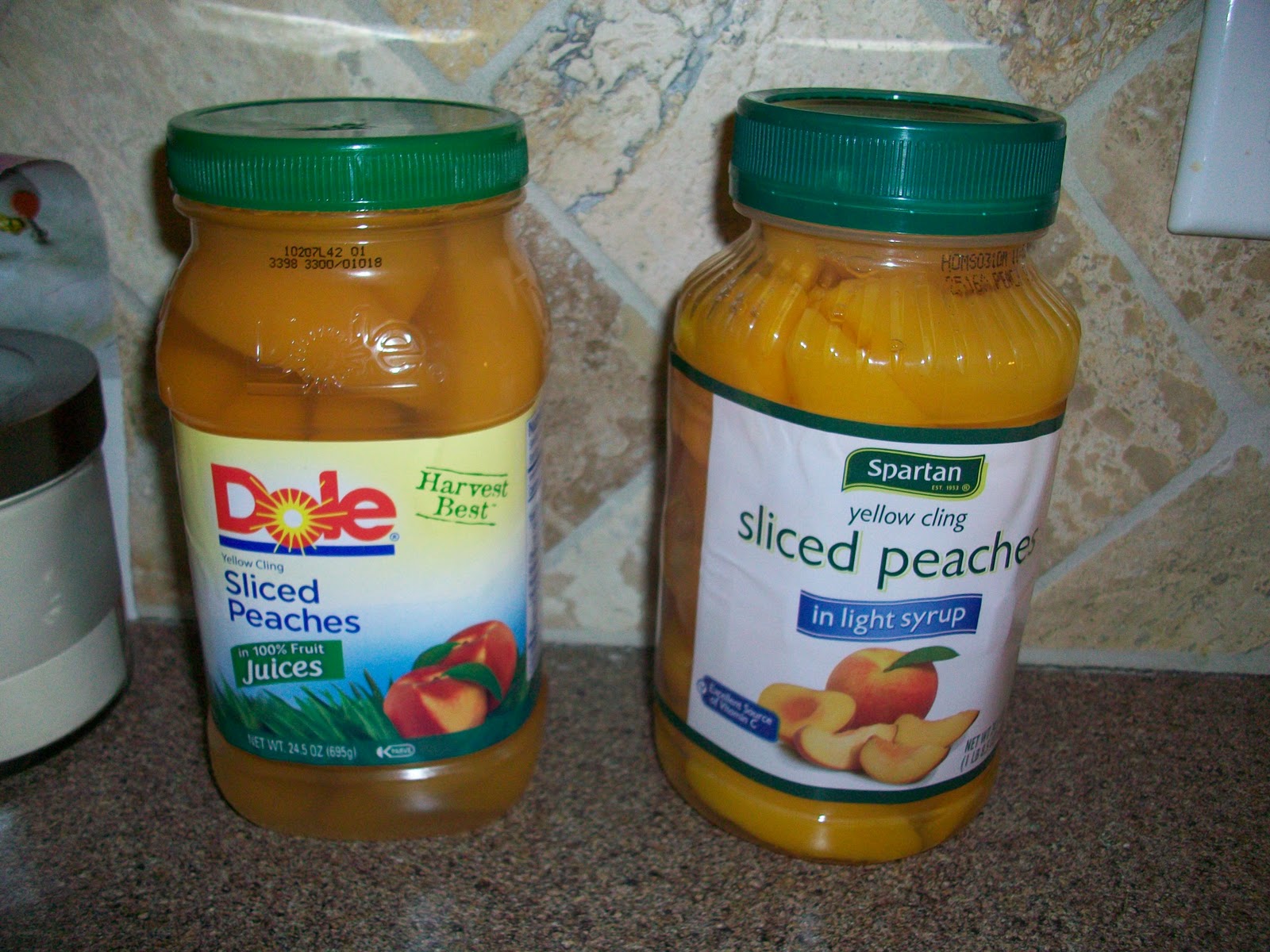
Usually the challenge focuses on junk stuff that I wouldn't purchase regardless of brand, but this week included sliced peaches in a plastic container -- specifically Dole vs. Spartan.  Here are my findings:

The Dole brand ($2.99 -- less the $.75 coupon I had):

Pros:  Packed in 100% fruit juice (White grape and lemon juice from concentrate -- not peach juice as one might think), the peaches themselves were perfect in texture and burst with fruit juice when chewed, packages in recyclable #5 plastic (I prefer glass).
Cons:  Product on China (not that I don't like China, but it defeats the eating local movement and adds to carbon emissions having to send food around the world for a product that is readily available in the United States.

The Spartan brand ($2.79 -- I received it for free):

Pros: Product of the USA (though it doesn't say from where specifically or how they were grown).

Cons:  The peaches are packed in sugar water instead of fruit juice (should make you think twice when you see your kids drinking the "juice" that remains in their bowl); the plastic jar has no recycling information on it, adding to a permanent landfill near your hometown; the peaches are very firm (almost crunchy" and don't have that burst of extra fruit flavor when eaten.

Verdict:

For $.20 I will choose the Dole brand.  My son did drink the liquid in the bottom of his bowl without prompting (what kid wouldn't) and he did so with the sugar water from the Spartan brand.  That alone made me think that I wouldn't choose the Spartan brand again.  The last thing any of us needs is more refined sugar.  And, perhaps even bigger, I just cannot believe that Spartan would sell a product in a container that cannot be recycled.  The taste was close, but I preferred the texture and "burst" of the Dole fruit.  Winner:  Dole.

Try for yourself this week at a Family Fare near you and let me know what you think.